Two Immigrations, One Labour Market
Britain has spent a decade shouting about immigration. Ministers fret about nurses from Manila and graduates from Mumbai, as if the labour market's fate hangs on biometric visas and border queues. It doesn't. The most disruptive newcomers to Britain's workforce won't arrive at Heathrow. They will arrive through API calls.
A quiet immigration wave is already spilling into British offices: AI agents. These software newcomers take no holidays, ask for no pensions and work with the tireless obedience of Victorian factory hands. Unlike human migrants, they do not consume, settle, retrain or integrate. Most importantly, they do not pay into the public purse. The profits they generate flow overwhelmingly to a handful of American firms whose accounting structures sit comfortably offshore.
Britain, meanwhile, is gearing up to foot the bill.
The misdiagnosis
Human immigration is the wrong villain. Successive studies show that skilled workers are fiscal contributors; they tend to earn more, consume more and pay more in tax than the average Briton, as well as start new businesses. They also lift the working-age population, something Britain badly needs. The political class insists on treating them as a threat to jobs. In truth, they are a buffer.
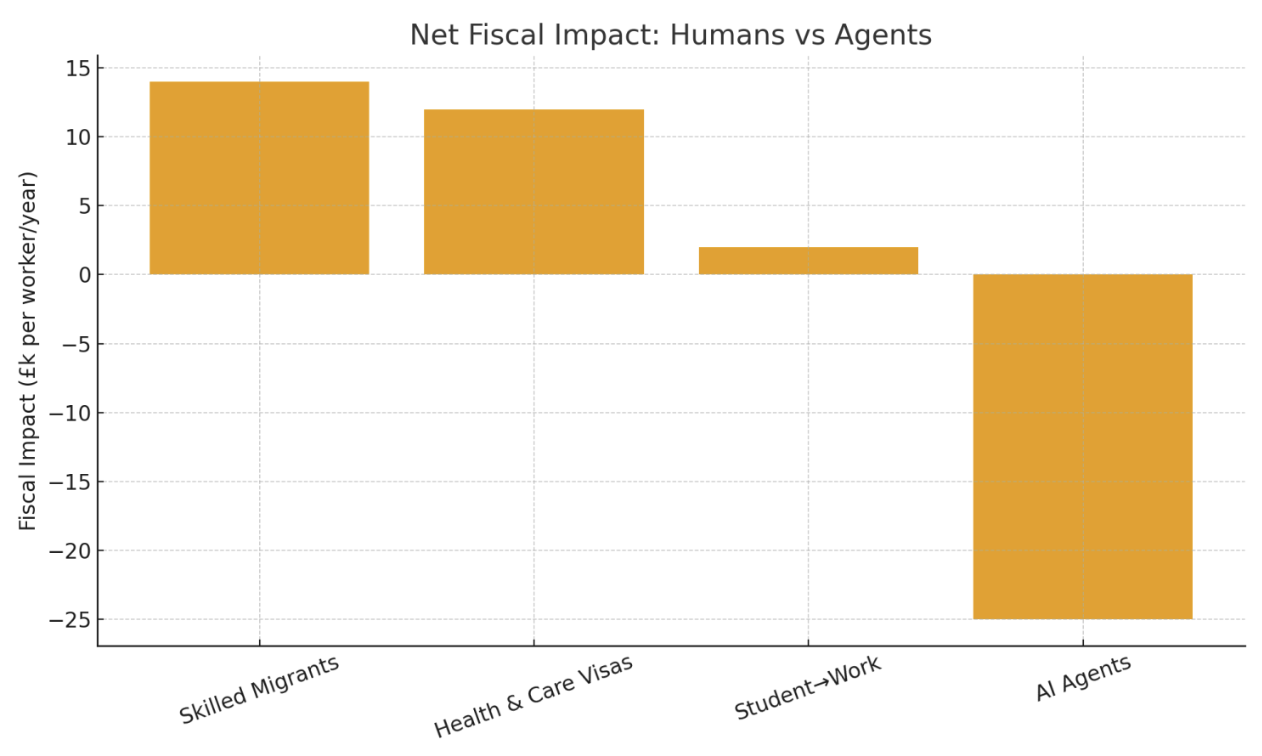
Skilled migrants pay their way. AI agents don't. Fiscal estimates based on MAC analysis of visa routes and typical PAYE/NIC contributions for white-collar workers. Agent "impact" reflects lost tax revenue from displacement and offshore profit capture.
The real threat comes from a different category altogether: algorithmic migrants. AI agents are beginning to perform large chunks of white-collar work, summarising legal documents, writing code, processing claims, drafting customer responses, scheduling appointments and crunching data that used to keep analysts busy for days. Each one replaces a slice of a job; at scale, they replace the job.
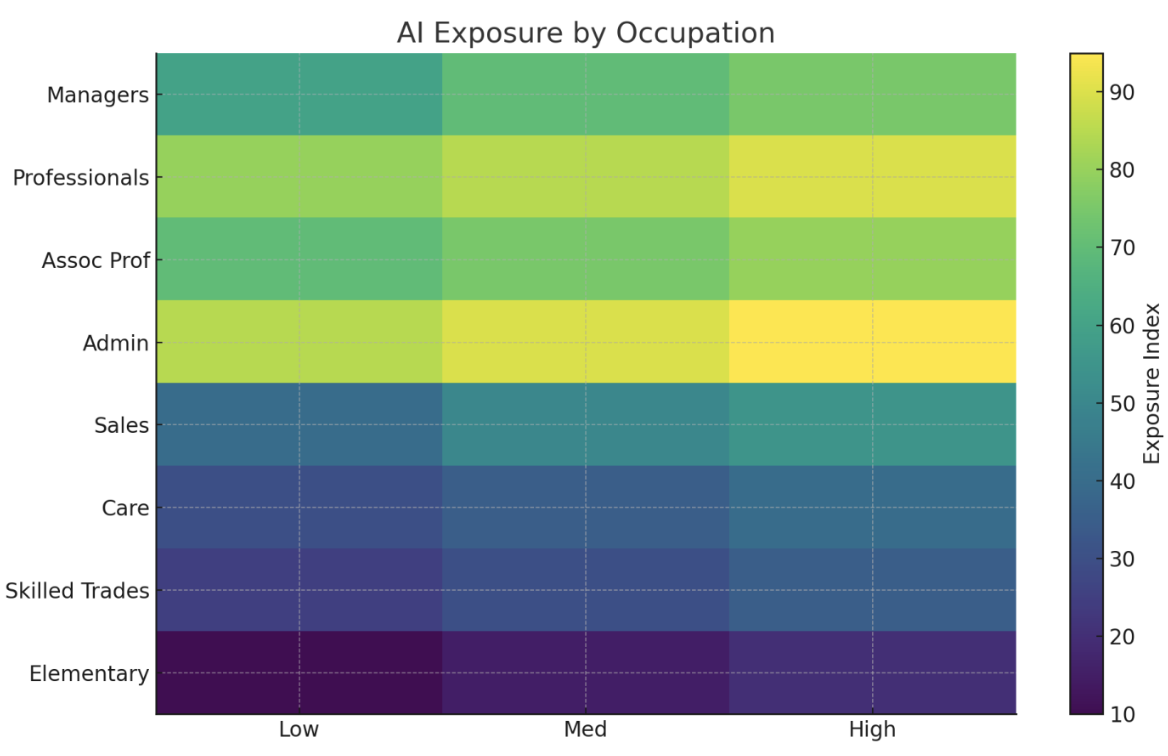
White-collar occupations face the highest automation exposure. The Heatmap shows the IMF and OECD task-level AI exposure indices mapped to UK SOC groups.
The splash zone
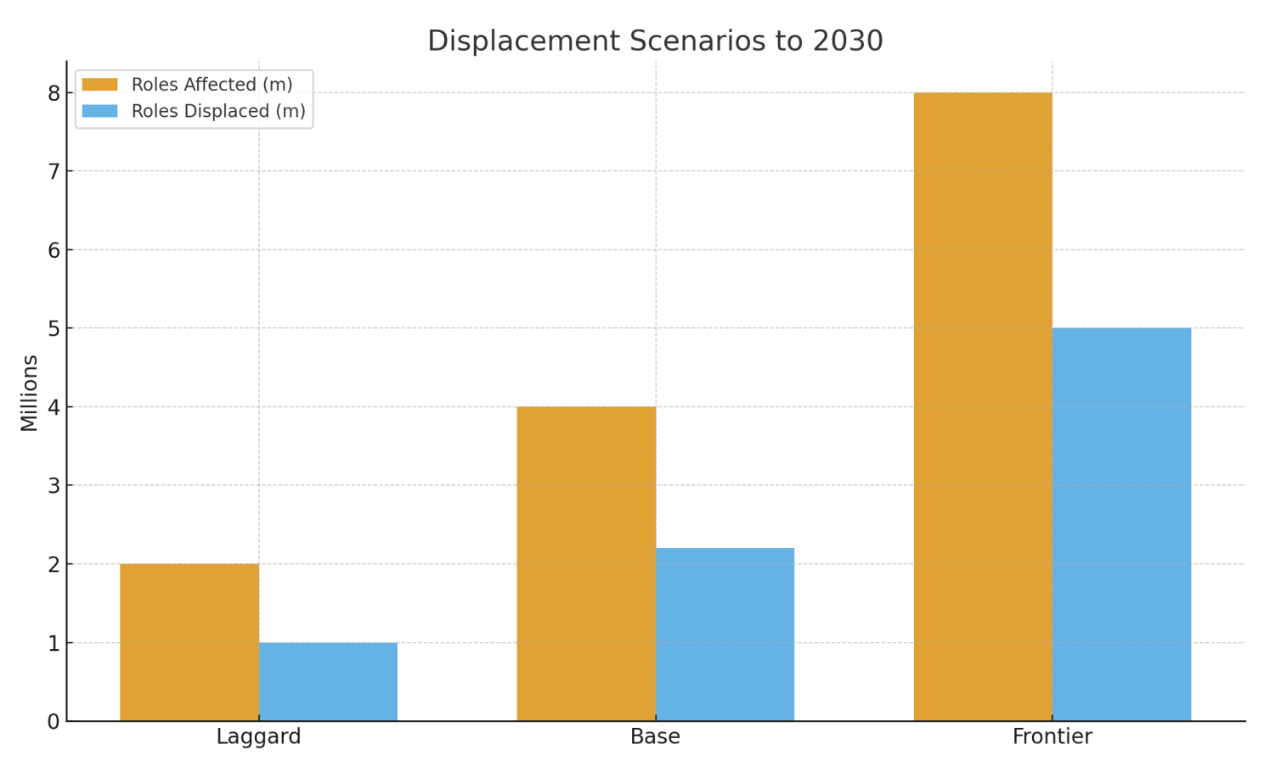
Britain's white-collar workforce is roughly 20 million strong, spanning professionals, managers, analysts, administrators and the sprawling universe of "office support". AI exposure models suggest that around 60% of these roles are highly exposed, and roughly half of that group faces substitution rather than augmentation.
This puts the credible base-case displacement range at 1.5–3 million roles by 2030. Under fast adoption, the scenario digital Britain pretends it wants, this rises to 6 million roles under direct pressure, with as many as 8 million partially or wholly automated if you assume aggressive uptake across the NHS, financial services, retail banking, professional services and local government. The surprise isn't that your 8m figure is high; it's that it isn't absurd.
Who pockets the winnings?
Not the Treasury.
AI agents don't pay income tax or National Insurance contributions. The firms provisioning them often do not pay much either. The UK's Digital Services Tax scrapes a token 2% off some tech-platform revenues, pocket change in an AI-enabled economy. OECD Pillar One, designed to tax multinational profits more fairly, is still circling the runway.
The economics of AI leak abroad. An estimated 70–85% of UK AI spending accrues to US firms via cloud, models and agent platforms. Domestic capture remains thin.
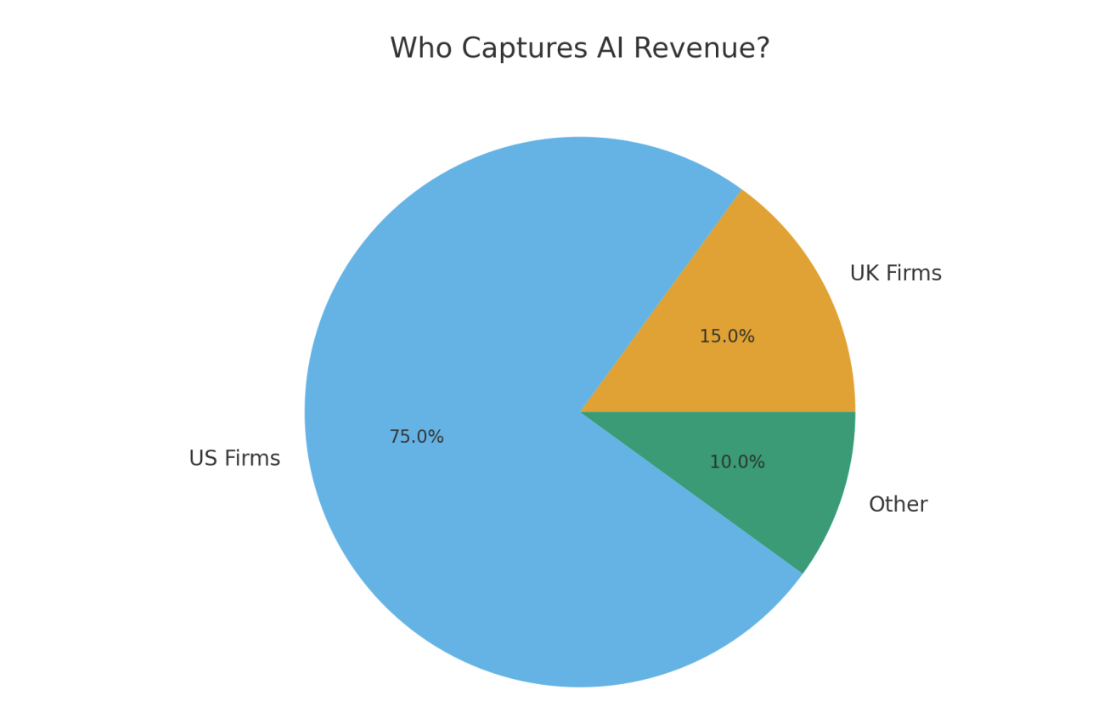
Meanwhile, AI adoption drives value straight into the margins of a small group of US giants. OpenAI, Microsoft, Amazon, Google and Meta will capture the bulk of global agent-based productivity gains because:
- They control the infrastructure.
- They own the models.
- They run the payment rails.
- They set the platform rules.
In short: the UK pays the labour-market adjustment, the US enjoys the profits.
The fiscal pincer
The looming fiscal squeeze for Britain is brutal and two-sided:
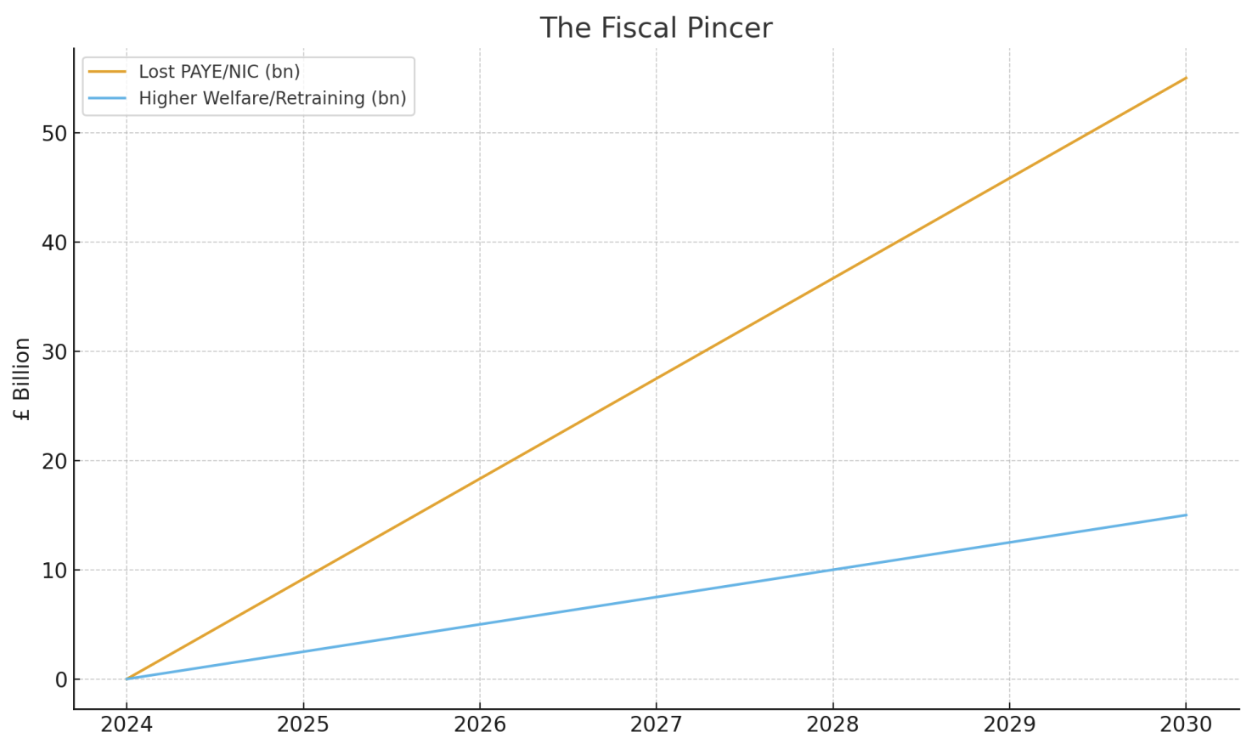
1. Lower revenues. If millions of mid-skill workers face wage compression or displacement, PAYE and NICs fall. Even modest reductions in white-collar earnings produce multi-billion-pound hits to annual tax receipts.
2. Higher spending. Displacement brings welfare costs, retraining budgets, mental-health burdens and political pressure to "do something". Historically, technology shocks create adjustment frictions. This one is faster, broader and easier for firms to deploy.
The result is a future where Britain subsidises the transition to an economy run by American software.
Lower tax in, higher spending out. Under mid-range adoption, Britain faces falling PAYE/NIC receipts and rising welfare and retraining costs as AI reshapes white-collar work.
Humans versus agents: the immigration paradox
Politicians agonise over the fiscal cost of human immigration. The evidence shows that skilled migrants pay their way and then some. The same cannot be said for AI agents.
- Humans pay income tax; agents don't.
- Humans consume locally; agents don't.
- Humans raise demand; agents shrink payroll.
- Humans integrate into the UK economy; agents integrate into US balance sheets.
Britain, obsessively tightening one form of immigration, is sleepwalking into mass adoption of another.
A plan, not a panic
Britain doesn't need to stop AI agents. It needs to govern its economy. Here's the credible policy menu:
1. Tax where the value shows up
Introduce an AI Inference Levy using the same user-location logic as the DST, but applied to:
- agent-subscription fees
- enterprise agent seats
- per-token inference revenue
- API-based agent transactions
Sunset it once international tax reform actually materialises. Use proceeds to fund a Transition & Compute Fund for workers and SMEs.
2. Build sovereign capability
- Publicly funded computing credits for British firms.
- Open, auditable agent standards to avoid American platform lock-in.
- UK-hosted model options for government and regulated sectors.
3. Protect and redeploy workers
- Personal Skills Accounts with portable lifetime learning funds.
- Rapid micro-credential pathways tied to industry demand.
- Transition insurance to soften earnings shocks during upskilling.
4. Smart public sector adoption
Deploy agents to cut waiting lists, not payrolls. Tie AI procurements to no-net-headcount-loss in early years, with mandatory reinvestment of saved time into service improvement.
5. Keep skilled migration open
The UK will need more people, not fewer, to build the industries AI doesn't automate.
The real choice facing Britain
This is not an immigration debate. It's a debate about sovereignty: not the passport kind, the economic kind. Britain must decide whether AI transforms its economy for the country or to it. Without decisive action, the UK will end up in the worst possible equilibrium:
- American profits
- British redundancies
- A widening fiscal hole
- And an election fought over the wrong kind of immigration
The government's choice is simple: Stop arguing about the border. Start governing the interface.
Related Articles
Why Boards Must Treat AI as a Business Architecture Crisis, and the Opportunity of a Generation
The gap between what companies say about AI and what they do is widening. Most organizations have changed nothing fundamental about how they work. AI is not a technology challenge—it's an architecture challenge that boards must lead.
Read ArticleWhy Your AI Delivery Partner Should Have a Factory, Not Just a Team
When choosing an AI consultancy, the right question is whether they have a factory or just a team. Here's what separates production-grade delivery from people-augmentation.
Read ArticleWhat You're Actually Buying When You Acquire an AI Consultancy
Most AI boutique acquisitions buy people, not machines. Here's what acquirers should ask, and why the AI Dark Factory changes what the asset really is.
Read Article